Hub architecture: resources and interaction
Libertas Hub is the execution and coordination core of the Libertas platform. It connects human users, AI and applications through managed resources, application descriptions and typed data interactions. This is the runtime foundation for the platform's collaboration goal.
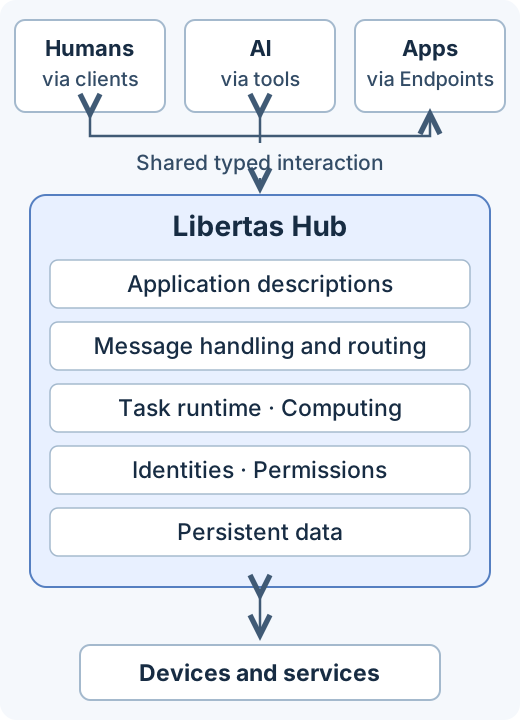
Conceptual roles and responsibilities. Participants may share a Hub; AI features require configured, authorized connectors.
Managed resources
Resource management provides the foundation for application execution:
- Computing and task resources. The Hub manages installed App versions and configured tasks, provides their runtime environments, and controls their lifecycles. It coordinates access to computing resources, devices and external services. Task isolation and declared permissions govern the resources an App may use; the network access contract defines its TCP and UDP access.
- Security resources. The Hub manages identities, users, groups and permissions, authenticates access, and authorizes resource operations. Administrative admission and resource permissions govern management; Request access governs human and AI invocation of Endpoint operations. Task-process permissions separately govern an App's access to platform resources.
- Data resources. The Hub stores persistent configuration and application records and provides the Data API used by tasks. Data access and task lifecycle remain platform responsibilities under the persistence contract.
Application descriptions and runtime interaction
Application descriptions give participants shared meaning. Studio extracts and validates source declarations; the Hub manages and serves schemas, localized documentation and Display Templates alongside installed App versions. They describe data structure and constraints, operations, human-readable meaning and presentation. The deployment contract defines exact version bindings; the Display Template contract explains presentation updates independently of App versions.
Runtime interaction puts these descriptions into operation. The Hub handles and routes typed Requests, Responses, subscriptions and updates between clients and App tasks, and between cooperating tasks. It maintains interaction ownership and enforces applicable access checks. The Endpoint contracts define the participant roles and message behavior; humans, AI and software share the declared protocol while retaining their applicable lifecycles.
Human users and AI
For human users, application data becomes a usable interface. Clients turn declared values and operations into forms, choices, actions, results and live updates. People can inspect information, make explicit decisions and complete App-defined workflows through consistent controls. Direct GUI interaction remains available independently of AI. See task controls.
For AI, schemas and documentation describe the available operations, their inputs and their results. The Hub projects eligible Endpoint operations into schema-described tools. An assistant can relate a person's intent to these operations, invoke App behavior, and use structured results to explain outcomes, analyze data and coordinate supported sequences of work. The Hub checks each tool invocation against the authenticated user's current permissions. Supported features also include AI Search among offered page destinations and document import into declared editor fields. Control AI requires an available, supported connector assigned to the signed-in user; each feature retains its own eligibility, confirmation and submission rules.
Human developers and coding agents maintain domain types, descriptions and behavior that serve human interfaces, AI tools and application integration together. Apps own domain meaning and business decisions; the Hub supplies shared runtime services and coordination; clients present the interaction to people. The App model defines this shared contract with an example; the code organization practice shows how to organize its implementation.